Assess your organisation's sustainability approach and integration maturity level for value creation, resilience, and impact.
Nov 12, 2026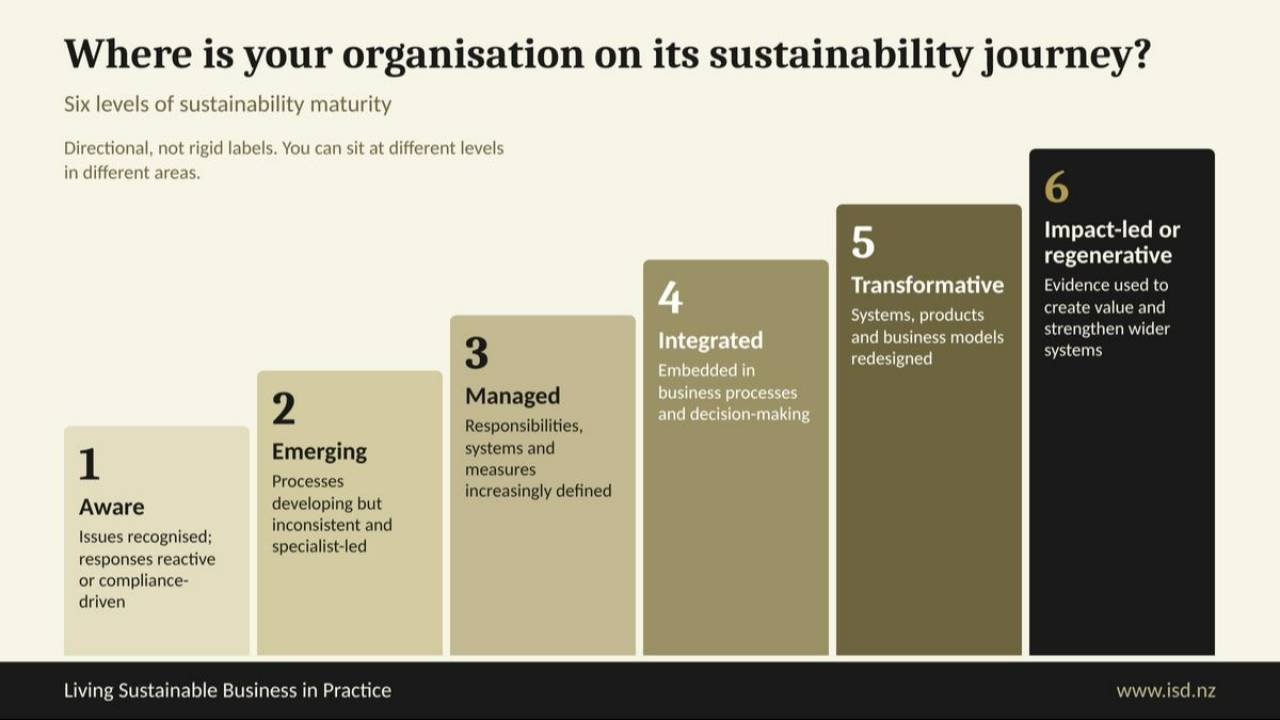
Where is your organisation on its sustainability journey?
The focus is increasingly moving towards managing financially material sustainability risks, better evidence and integration into investment decisions, evidence-based reporting and proactively contributing to value chain nature and people dependencies.
Most organisations we work with can tell us what they are doing on sustainability. Far fewer can tell us where their intentions actually are with intentions, data and targets. That gap matters. Without an informed picture of your current baseline, it is hard to choose the right next step, to set priorities, or to make claims you can stand behind.
“Sixty percent of people surveyed said they were prepared to invest time and money to support companies doing good… almost half (49%) said they had stopped buying certain products because of their environmental impact.” (Kantar and the Sustainable Business Council, Better Futures 2025.)
“In New Zealand, 87% think businesses should take responsibility for their environmental and social impacts (Kantar and SBC, Better Futures 2026), and globally 85% say they worry about environmental sustainability (Bain & Company, 2026).”
Join us for a 90-minute Masterclass (19th November, 10 December, 21 January to collate and evolve your organisation’s sustainability integration, value creation, resilience, impact and adaptation pathway.
Why assessing maturity is important
- It replaces guesswork with evidence. You can see strengths, gaps and what is holding progress back.
- It focuses effort. Instead of trying to do everything, you choose the next capability to build.
- It builds credibility. A candid baseline supports claims that are accurate, balanced and evidence-based.
- It brings people together. Leaders, teams and stakeholders get a shared language for talking about progress.
- It shows progress over time. You can return to it as the business learns and changes.
- It enables you to identify focus areas to pathway your organisation.
Good practice organisations are evolving their sustainability approach to be integrated, inform decision-making and funding, and proactively transform business models and contribute to value chain regeneration, including people and the environment. This enhances resilience and demonstrates a purpose-led organisation proactively contributing to the economy, people, communities and the environment.
Most organisations have multiple parts of the line of sight, but few link them so they can be updated, responded to, and shared with stakeholders.
To be credible and evidence-based, each organisation needs a line-of-sight pathway from purpose, values, context, materiality, ambition, risk, goals, actions, data collection tools, reporting, communications, and learning, which can be updated.
This pathway ensures that progress, impacts, issues and roles can be shared, elevated, and responded to in a timely manner. Triangulating data on key progress and impacts, and evolving opportunities, is key to enhancing resiliency, efficiency, and contributions to people and the environment.
Collating and assessing the line of sight enables managers, board members, and teams to integrate sustainability into governance and operational processes credibly.
Who – learning for all in some areas, given the multi-disciplinary skills and knowledge needed.
Relevant for managers, board members, team leaders, accountants, lawyers, sustainability specialists, and communication and marketing personnel looking to expand knowledge, practice, and capability. Register at
Aims of the Masterclass include:
- Discussing what a ’credible’ line of sight means using the Sustainable Business Framework Approach.
- Supporting organisations to collate, develop and demonstrate a credible line of sight from purpose, goals, material (big rocks) issues/opportunities, actions, evidence, reporting and learning.
- Supports integrating sustainability as part of an adaptive business model to enhance value creation, resilience, risk management, reporting and learning.
By the end of the Masterclass, you will have:
- A clear picture of the Framework and the Approach, and where your organisation sits in the nine-phase cycle.
- A first draft of your own Framework Canvas (Template A), so that purpose, context, choices, action, evidence and learning are in 1 working document.
- Your Diagnostic scores (Template B) across the 13 areas, with your three strongest capabilities and three biggest gaps.
- An assessment showing your current maturity level and areas to enhance.
- One immediate priority, and the capability to build next steps.
- A map of Templates C to M, so you know which one to reach for next.
- An opportunity to book a 1:1 complementary 30 min session with Dr Kate Averill.
- Will be registered in the ISD Community. 3 monthly webinars, shared resources and shared practice discussions.
Evolve your sustainability approach, actions and impacts!
For Masterclass details