From Intent to Impact: The Living Sustainable Business Framework Approach
Oct 12, 2026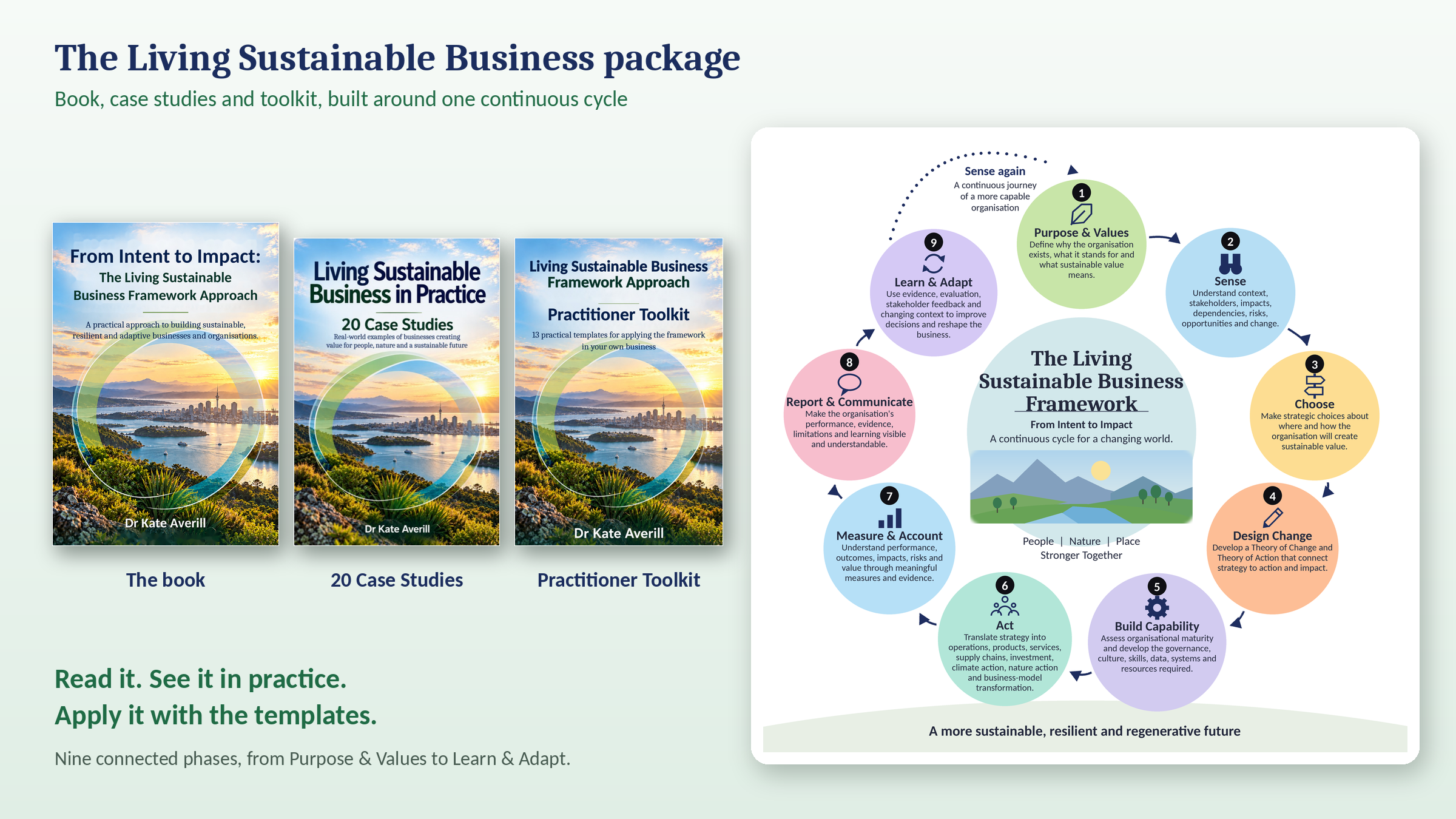
Dr Kate Averill has, over the past two years, worked with over 150 organisations and this guidance, case studies and practitioner toolkit is designed to expand sustainability capability and impact. Have a look, and there are areas for all to evolve in our changing world.
Kia ora koutou, Greetings,
This winter in Aotearoa, New Zealand, I have reflected on how to better support organisations to evolve their sustainability approaches. Most organisations I meet have strategies, targets, reports and initiatives. What they often lack is a way to connect them. There also appears to be intent-to-action-to-impact gaps. In addition, I sometimes cannot understand how some sustainability reporting is developed. My evaluative thinking tries to follow the line of sight from intention and action to evidence and impact. So much effort seems to be going into different sustainability activities. Then I reflected on what an effective balance of time and resources looks like to achieve actual impacts for people and the planet.
To reflect further: What if sustainability wasn't something added to business, but part of how the business itself works? I evolved these reflections into a Living Sustainable Business Framework Approach that links purpose and values with context, strategy, risk, resilience, capability, action, evidence, reporting, and learning, so sustainability can shape decisions rather than sit beside them. This thinking and development grew from our practical sustainability and evaluation experiences supporting businesses and organisations, and from my PhD research.
So, sharing with you: The Living Sustainable Business Framework Approach. There are nine connected phases: Purpose & Values. Sense. Choose. Design Change. Build Capability. Act. Measure & Account. Report & Communicate. Learn & Adapt. They are a cycle, because the world keeps changing and so must the organisation. After you learn and adapt, you sense again. The questions in each phase help identify the 'big rocks' material areas/issues to focus on.
There is no finish line: Are we sustainable yet? appears to be the wrong question. Organisations work within living systems that keep changing, so sustainability has no final state. A better question is: are we getting better at understanding our impacts, making deliberate choices, acting, measuring, listening and learning? That capability is what makes a business or organisation a Living Sustainable Business.
Who this helps: The framework is for leaders, boards, managers, and sustainability practitioners who want better questions, more focus on material areas/issues, clearer decisions, and credible evidence. It works at organisation level, for a business unit, or for a single strategic priority. Some communities and regions are also taking a collective impact approach to strengthen practice, shared impacts, and learning. This framework helps us support people and organisations as they evolve in response to climate change, global contextual changes, innovation, and customer needs. We are identifying good practice in different areas, including regeneration, collective action, shared contributions, and learning. I look forward to sharing our emerging case studies and practice tools. Have a look, and there are areas for all to evolve in our changing world. Kindest regards, Kate.
For further information. www.isd.nz
For Information on resources and services
